
Petrol Price Forecasting
and Scenario Analysis
A forecasting case study using Germany E10 petrol price data to model short-term price scenarios and support budgeting, procurement, and cost-risk awareness.
Business Problem
Fuel prices directly affect transportation, logistics, procurement, supplier costs, fleet operations, and financial planning. When petrol prices rise unexpectedly, organizations can face higher operating costs, tighter margins, and weaker budget accuracy. The challenge was to use historical fuel price data to anticipate short-term price movement and support earlier, more informed planning.
Analytical Objective
To build a forecasting workflow that analyzes historical petrol price trends, prepares time-series data, compares multiple forecasting approaches, and translates short-term price scenarios into practical business planning insight.
Key Questions Answered
- How did petrol prices evolve from 2023 to 2026?
- Did the data suggest relative stability, gradual pressure, or sharp upward movement?
- How do different forecasting models interpret the same short-term future differently?
- Which forecast patterns are most useful for budgeting and operational planning?
- How can scenario-based fuel forecasting support cost-risk awareness and procurement preparation?
Highlight
Built a multi-model forecasting workflow using Linear Regression, ARIMA, LSTM, and AutoKeras to translate petrol price history into short-term planning scenarios for budgeting, procurement, and cost-risk monitoring.
Methods and Tools
Data Context
- Germany E10 petrol price data
- daily time-series observations
- coverage from 2023 to 2026
- target variable: petrol price per litre
- final cleaned dataset: 1,209 records
Tools and Models
- Python
- Pandas
- NumPy
- Plotly
- Scikit-learn
- Statsmodels
- TensorFlow / Keras
- AutoKeras
- Time-series forecasting
- Scenario comparison
Why Germany E10 Petrol Was Used in This Project Instead of Swiss Petrol
Germany E10 petrol data was selected because it offers a rich, structured, and frequently updated time-series dataset suitable for forecasting. Compared with Switzerland, Germany provides stronger public fuel price data availability and more price movement for model comparison. The goal of the project was not country-specific reporting, but to demonstrate a forecasting framework that can be applied to any fuel market or business cost dataset when reliable historical data is available.
Workflow
- loaded and standardized historical petrol price data
- cleaned date fields, missing values, and time-series structure
- analyzed price behavior from 2023 to 2026 to identify stability and volatility patterns
- built multiple forecasting models, including Linear Regression, ARIMA, LSTM, and AutoKeras
- compared short-term forecast paths across models
- translated forecast outputs into scenario-based business interpretation
Key Findings
- Petrol prices remained relatively stable through most of 2023 to 2025 before a sharp upward shift emerged in early 2026.
- The 2026 price movement indicated a structural break from the earlier stable range, increasing cost uncertainty for short-term planning.
- Different forecasting models produced different short-term scenarios, reinforcing that forecasting should be used as a scenario-planning tool rather than a single-point estimate.
- ARIMA suggested near-term stabilization, LSTM reflected a more directional continuation pattern, and AutoKeras introduced a more alternative scenario view.
- The strongest business value of the project came from model comparison, which helped translate uncertainty into practical planning options.
Business Recommendations
- Use petrol forecasting as an early-warning input for budgeting and fuel-related cost planning.
- Build scenario-based assumptions around stable, rising, and corrective price paths rather than relying on a single forecast output.
- Connect forecast scenarios to company-specific fuel usage, logistics exposure, and supplier transport costs.
- Monitor short-term forecast shifts regularly to detect emerging cost pressure earlier.
- Use model comparison to support procurement timing, operational planning, and broader cost-risk awareness.
Figure 1 shows Linear Regression Forecast: This baseline forecast provides a simple short-term reference view following the sharp petrol price increase in early 2026. It suggests near-term stabilization within a narrow range, making it useful as a comparison anchor rather than a final decision model.
Figure 2 shows ARIMA Forecast: The ARIMA model suggests short-term stabilization around the current elevated price level. As a traditional time-series approach, it offers a conservative planning scenario that may be useful for budgeting, procurement, and short-term cost monitoring.
Figure 3 shows LSTM Forecast: The LSTM forecast captures sequential price behavior and suggests that recent upward pressure may still influence the short-term path. This model adds value by reflecting pattern continuation risk in a way that may not be fully captured by more traditional models.
Figure 4 shows AutoKeras Forecast: The AutoKeras forecast introduces an alternative short-term scenario and shows how automated model selection can produce a different directional view of the same price history. Its value lies less in certainty and more in expanding the scenario range available for planning.
Figure 5 shows Integrated Forecast Comparison: This integrated view compares multiple forecasting models against the actual Germany E10 petrol price trend. The divergence across forecast paths shows that short-term fuel prices remain uncertain, making scenario-based planning more valuable than depending on a single projected outcome.
Figure 6 shows a Pareto Analysis of Daily Price Movements for E10 fuel. Each day in the sample is ranked by the size of its absolute price change and plotted against the cumulative share of total movement it contributes, testing whether a small number of days drive most of the volatility. The data shows moderate concentration: the most volatile 20% of days (roughly 242 of 1,208 days) account for about 54.2% of total price movement, while it still takes about 44.4% of all days to reach the 80% mark. This falls short of a strict 80/20 pattern, but confirms that a meaningful share of days drive a disproportionate share of volatility — useful for prioritizing which periods warrant closer forecasting attention.
Why This Matters
This project demonstrates how forecasting can move business decision-making from reactive cost management toward earlier, more structured planning. Fuel prices influence transportation, logistics, procurement, supplier charges, fleet operations, and financial forecasting, so even short-term price shifts can have meaningful operational and budget consequences.
By modeling multiple short-term price scenarios rather than relying on a single fixed prediction, the project shows how historical time-series data can be translated into practical cost-risk awareness. The real value lies not in predicting the future perfectly, but in preparing decision-makers for a range of plausible outcomes.
What This Project Demonstrates
- time-series forecasting using real-world price data
- structured data cleaning and feature preparation
- comparison of classical, machine learning, and deep learning models
- ability to interpret forecasting uncertainty through scenario analysis
- ability to translate technical model outputs into business planning insight
Recommended Planning Model
For this project, ARIMA was selected as the primary planning model because the dataset is a single-variable time series based on historical petrol prices. ARIMA is specifically designed for short-term time-series forecasting and provides a more explainable and business-defensible planning view than more complex deep learning or automated machine learning models.
While LSTM and AutoKeras add analytical depth, they are better positioned as scenario comparison models rather than the main basis for decision-making. LSTM can help assess the possibility of continued upward price pressure, while AutoKeras provides an alternative automated modeling perspective. Linear Regression remains useful as a simple baseline model.
The recommended approach is to use ARIMA as the expected planning case, supported by the other models as scenario checks:
Planning Scenario
Expected Case
Baseline Case
Upward Risk Case
Alternative Case
Model
ARIMA
Linear Regression
LSTM
AutoKeras
Business Interpretation
Prices are expected to track the ARIMA baseline trend, the most business-defensible planning reference
Prices may remain within a narrow short-term range
Prices may continue increasing mildly
Prices may correct downward after the recent spike
To validate this choice, all four models were backtested on a 30-day held-out period (March 25 – April 23, 2026) not seen during training:
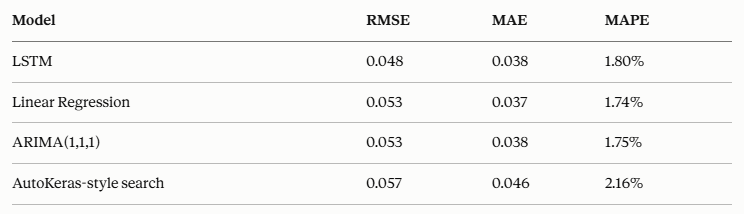
LSTM edged out the lowest RMSE, while Linear Regression and ARIMA were statistically comparable at roughly 1.75% MAPE, both outperforming the automated architecture search. The backtest shows that added model complexity did not meaningfully improve accuracy on this series, which reinforces ARIMA as the primary planning model on explainability grounds rather than a wide accuracy margin.
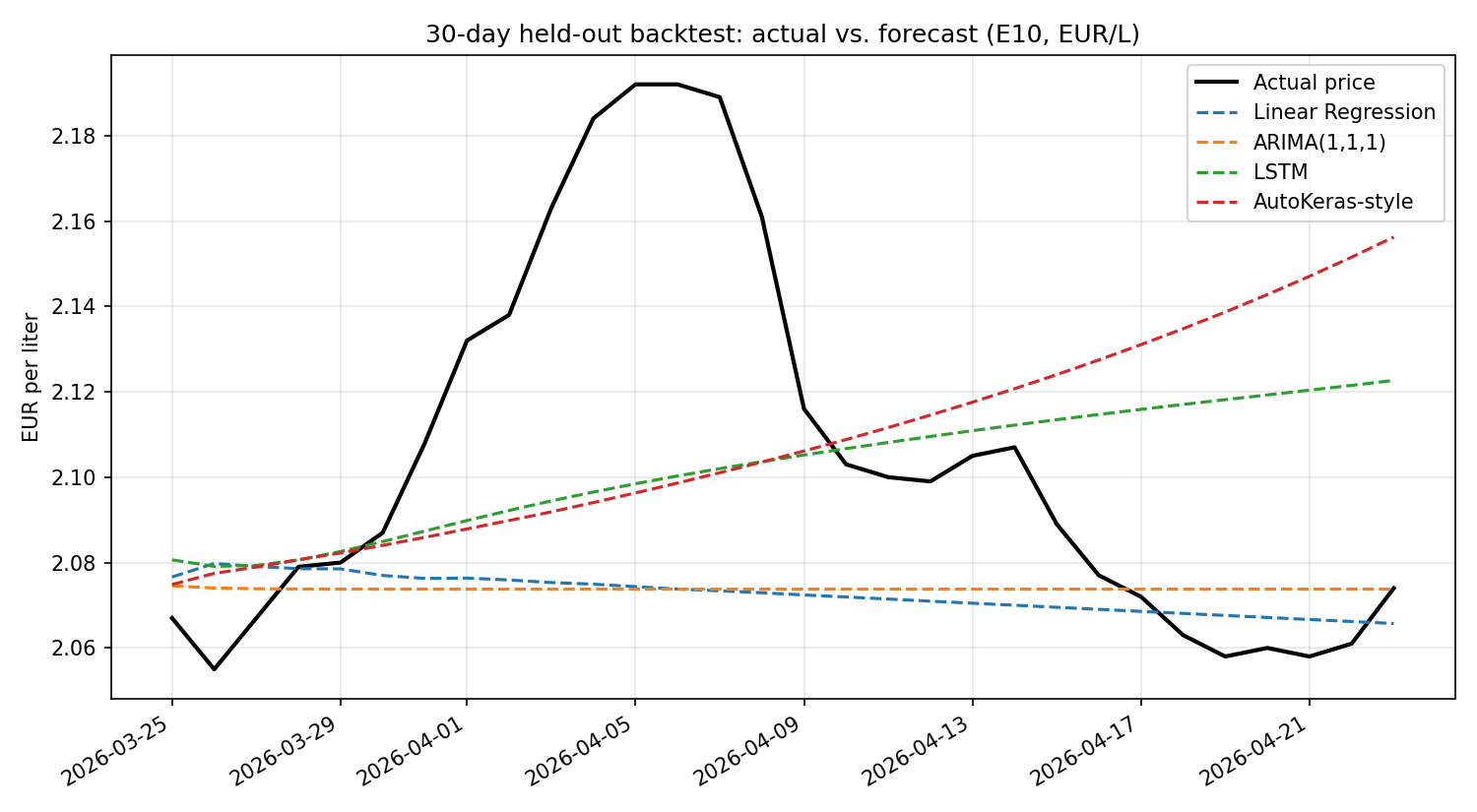
Figure 7 shows the 30-day backtest: actual E10 prices against each model’s forecast on data withheld during training, the basis for the accuracy comparison above.
Conclusion
This project demonstrates how time-series forecasting can support practical business planning when price-sensitive operational costs are involved. By analyzing Germany E10 petrol prices from 2023 to 2026 and comparing multiple forecasting models, the analysis transformed historical fuel price behavior into short-term planning scenarios that support budgeting, procurement, logistics planning, and fuel cost risk monitoring.
The project also highlights the importance of using forecasting as a decision-support tool rather than treating it as a fixed prediction. ARIMA was selected as the primary planning model because it provides a suitable and explainable forecast for a single historical petrol price series, while Linear Regression, LSTM, and AutoKeras were used as supporting scenario models to compare baseline, upward-risk, and alternative correction views.
Beyond the forecast output itself, this project demonstrates a structured analytical approach: moving from raw time-series data to data cleaning, model development, forecast comparison, scenario interpretation, and decision-oriented communication. Its real value lies in helping leadership understand possible cost movements earlier, prepare for uncertainty more confidently, and make more informed operational and financial planning decisions.